
Garza County Criminal History Checks
Start by naming the exact Garza County record you need. A current custody question belongs with the jail. An incident or arrest report belongs with the agency that made it. A filed felony or misdemeanor belongs with the combined District and County Clerk. Fine-only city cases go to Post Municipal Court. Texas DPS holds a statewide criminal-history summary, but its public search is limited to reported convictions and deferred adjudications. TDCJ covers people transferred to state custody. No single Garza portal joins those files.
Use a full legal name, birth date, prior name, cause number, booking date, or incident location when known. Those details reduce same-name errors and help a clerk locate a paper or internal-system record.
- Choose the sheriff, jail, court, DPS, registry, or prison channel that matches the record stage.
- Call the Garza County jail first for current custody because no public web roster exists.
- Ask the combined clerk to search by name, cause number, and filing year for a local case.
- Use DPS CCH for reported statewide convictions and deferred adjudications, not recent arrests.
- Order a certified disposition or fingerprint review when identity or a final outcome must be verified.
The official Garza County government site shows the county office directory.
That directory is the starting point for offices that do not offer a public record database.
Four Garza County Record Systems
A booking record, court file, DPS line, and TDCJ custody result answer different questions. The jail record is an intake snapshot. The clerk file shows what prosecutors filed and how the court ruled. DPS links reported events to a state identity record. TDCJ begins after a person enters state prison custody or supervision. A booking charge can change before filing, and a filed charge can end in dismissal or acquittal.
| Channel | Best Use | Key Limit |
|---|---|---|
| Garza sheriff and jail | Incident, arrest, booking, and current custody | No online roster |
| Combined clerk | Docket, filings, judgment, and certified disposition | Direct request, not a public portal |
| Texas DPS CCH | Reported convictions and deferred adjudications | Name result is not fingerprint identification |
| TDCJ IVSS | State custody and release information | Does not cover the county jail |
Record flow is best read as: Arresting agency › jail intake › prosecutor and court › clerk disposition › DPS reporting.
Official Background Checks in Texas
The Texas DPS Criminal History Conviction Name Search lets the public buy credits and search reported convictions and deferred adjudications. One credit costs $1. A no-match still uses a credit, and opening another possible person uses another. Exact and Soundex-like matching can return candidates, so add a middle or maiden name and complete birth date when possible.

The screen explains why the state name search is useful but narrower than a complete personal record review.
For a review of your own Texas record, use FAST fingerprints. DPS lists a $15 record check and a $10 fingerprint collection fee. The appointment system identifies the current site; research did not confirm an enrollment office in Garza County. A mailed CR-42 name search costs $10. An FBI Identity History Summary is a separate subject-only fingerprint product for federal data.
Note: A public DPS name result is narrower than the fingerprint-based Texas record a person can request for self-review.
Garza Records and Fingerprint Identity
A similar name is not a biometric match. Public DPS results can create false positives or miss events that were never reported or linked. The FAST IdentoGO enrollment channel captures fingerprints for the Texas personal-review process.
The appointment route is the stronger choice for someone checking their own identity-based state history. If a final disposition is missing, DPS instructs the person to obtain a certified court disposition. A plain copy without the court seal may not support the correction.
| DPS Field | Required | Use |
|---|---|---|
| Last name | Yes | Legal name, not an initial or partial name |
| First name | Yes | Legal first name |
| Middle or maiden name | No | Helps narrow candidates |
| Birth date | No | Complete or partial date can reduce mismatch risk |
Kinds of Criminal Records
Garza County criminal records are created in stages. An investigating officer writes the incident report. An arrest report states the custody action and probable-cause facts. The jail adds intake identity, fingerprints, booking charge, bond, and release status. Prosecutors create a complaint, information, or indictment. The combined clerk then keeps the docket, filings, hearings, plea, judgment, sentence, and costs.
- Warrant records originate with district, county, municipal, or justice courts; Garza has no combined public list.
- Supervision records pair a court judgment with local CSCD or TDCJ parole information.
- Incarceration records split among the adult county jail, TDCJ, and the federal Bureau of Prisons.
- Registry listings come from Texas DPS and omit protected victim and personal identifiers.
- Restricted records may involve juvenile confidentiality, expunction, sealing, or nondisclosure.
The county criminal court description confirms the clerk's misdemeanor role.
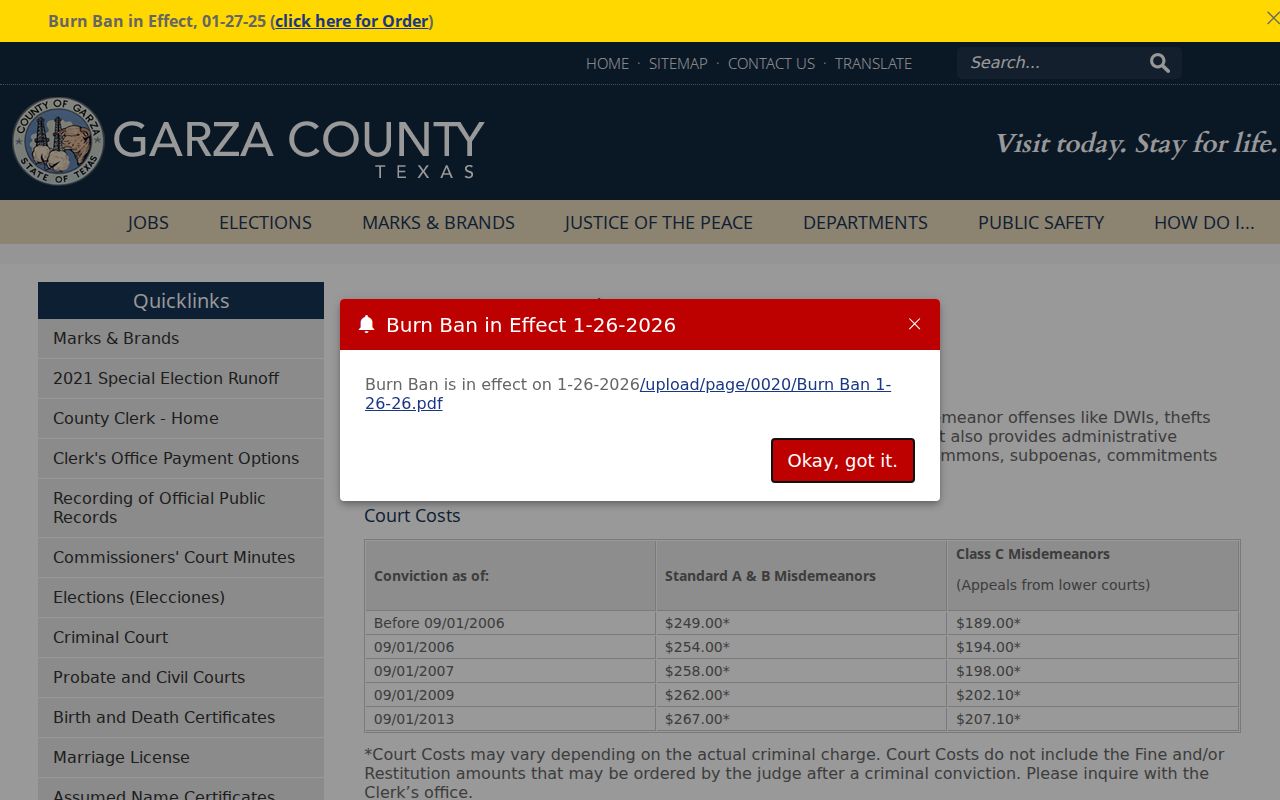
This local page helps separate County Court records from felony files in the 106th District Court.
Garza Criminal Records at One Counter
The combined District and County Clerk works from the first floor of the Garza County Courthouse, 300 West Main Street in Post. The office receives district criminal filings and keeps County Court misdemeanor records. Call 806-495-4430, fax 806-495-4431, email terri.laurence@co.garza.tx.us, or mail PO Box 366, Post, Texas 79356. Posted hours are Monday through Thursday from 8:00 a.m. to 5:00 p.m. and Friday from 8:00 a.m. to noon.
The combined clerk's official contact page shows the local counter and schedule.
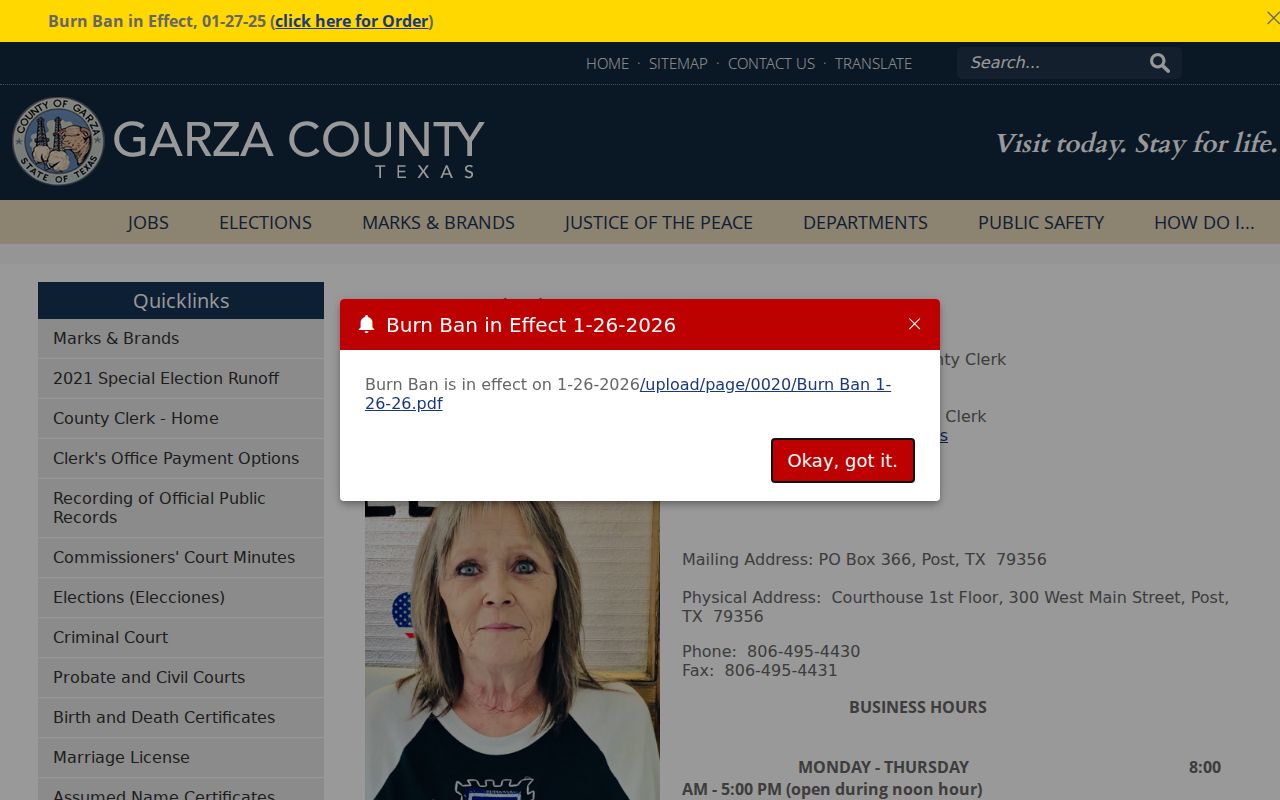
OCA identifies the office as a combo clerk using Local Government Solutions, but the county publishes no public LGS search. Ask for a name search, docket, charging paper, judgment, or certified disposition. The dated fee page lists $5 per file or case-number search and $1 per page for plain and certified copies. Confirm the current charge before ordering.
Combined District and County Clerk
300 W Main, first floor
Post, TX 79356
806-495-4430
Mon-Thu 8-5; Fri 8-noon
Garza Law Enforcement Center
412 E 15th Street
Post, TX 79356
806-495-3595
Jail: 806-990-9974
Note: Call the clerk before relying on its dated fee schedule or planning a Friday visit after noon.
Garza County Criminal Records: What They Contain
Read each field in light of its source. A DPS record groups identity and arrest cycles, then adds prosecutor and court events. A Garza court file is richer in local filings. A jail booking is limited to the custody period. The offense level shown may be the arrest charge, filed charge, conviction charge, or an enhanced sentence level.
| Name and identifiers | Legal names, aliases, birth date, and state or FBI numbers where present. |
|---|---|
| Arrest and booking | Date, reporting agency, intake charge, bond, and custody or release status. |
| Charges and statutes | Arrest allegations, later filed offenses, degree, and cited Texas law. |
| Disposition | Dismissal, acquittal, conviction, deferred adjudication, or another final result. |
| Sentence | Custody, fine, community supervision, restitution, and related orders. |
| Custody or supervision | County jail, TDCJ, probation, parole, or release information when public. |
- Disposition
- The outcome that resolves a charge.
- Docket
- The dated list of events in a court case.
- Deferred adjudication
- Supervision imposed while a finding of guilt is deferred.
- Nondisclosure
- A limit on public release that does not destroy all agency records.
When two sources disagree, compare the cause number, event date, agency, and stage before assuming either record is wrong. The certified court result is the best source for the final local disposition.
Garza Custody Records Split Three Ways
The adult Garza County jail is not the Regional Juvenile Center and is not the Giles W. Dalby Unit. In March 2025, official county minutes recorded 77 people in the adult jail, including 27 county inmates and 50 held for outside entities. Custody at that building therefore does not prove the arrest occurred in Garza County. Call the jail and ask for the arresting agency.
After a transfer to state prison, use the TDCJ IVSS Offender Search.
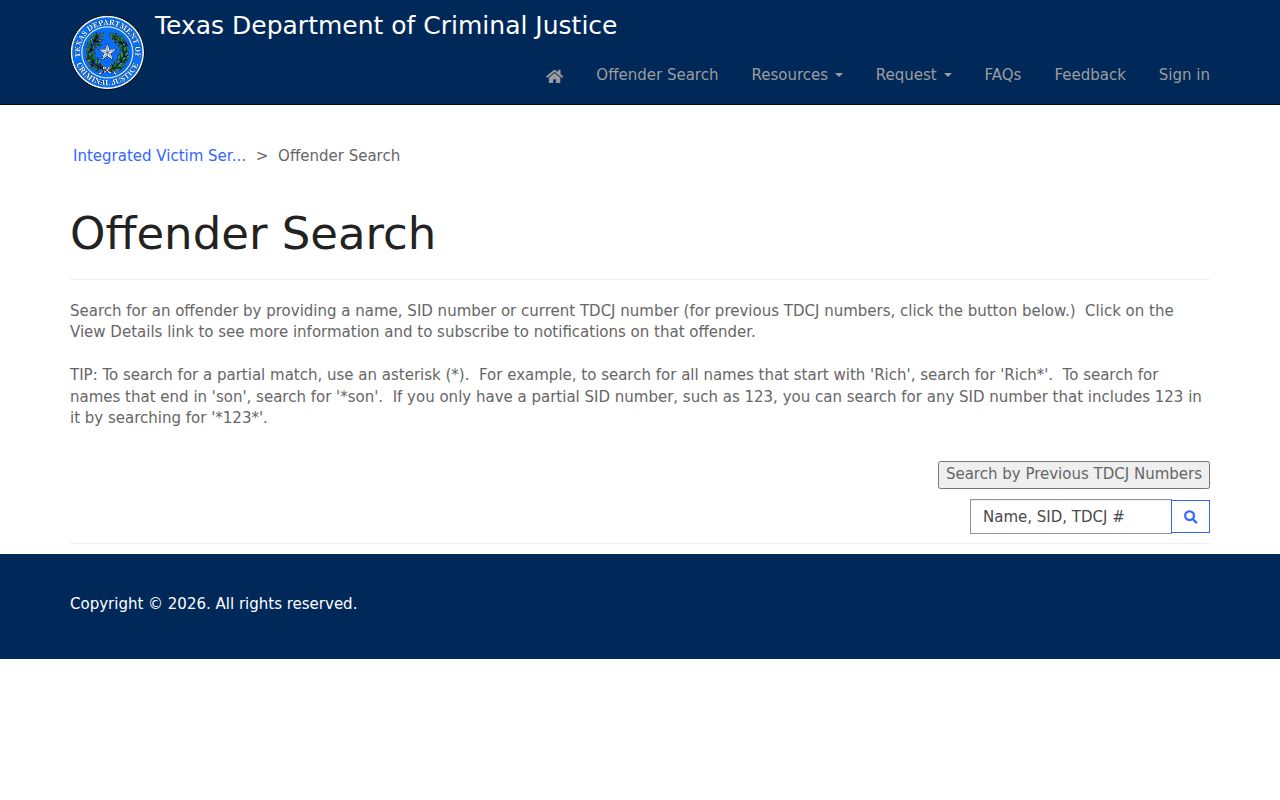
IVSS accepts a name, SID number, current TDCJ number, or previous TDCJ number and supports partial-name matching with an asterisk. It does not search the county jail. The Dalby facility closed in 2024, was purchased by the state in 2025, and reopened under TDCJ in February 2026, which makes this county and state custody split especially important.
Note: Custody in Garza County does not by itself identify the county where the arrest occurred.
Texas Public Access Laws
The Texas Public Information Act starts with a presumption of access to government records, subject to confidentiality and exceptions. Court case records follow the judicial access framework and are usually requested from the clerk. Restricted criminal-history information, juvenile files, victim identifiers, and protected personal data do not become public merely because someone files an open-records request.
Key Texas laws:
Government Code Chapter 552 governs public-information requests and exceptions.
Government Code Chapter 411 governs DPS release of conviction, deferred, and restricted criminal-history data.
Code of Criminal Procedure Chapter 66 governs reporting by police, prosecutors, and clerks.
Texas Rule of Judicial Administration 12 supplies the judicial-record access framework.
Code of Criminal Procedure Chapter 55A contains current expunction law.
The clerk's public-information request page lists email, mail, courier, and fax options.
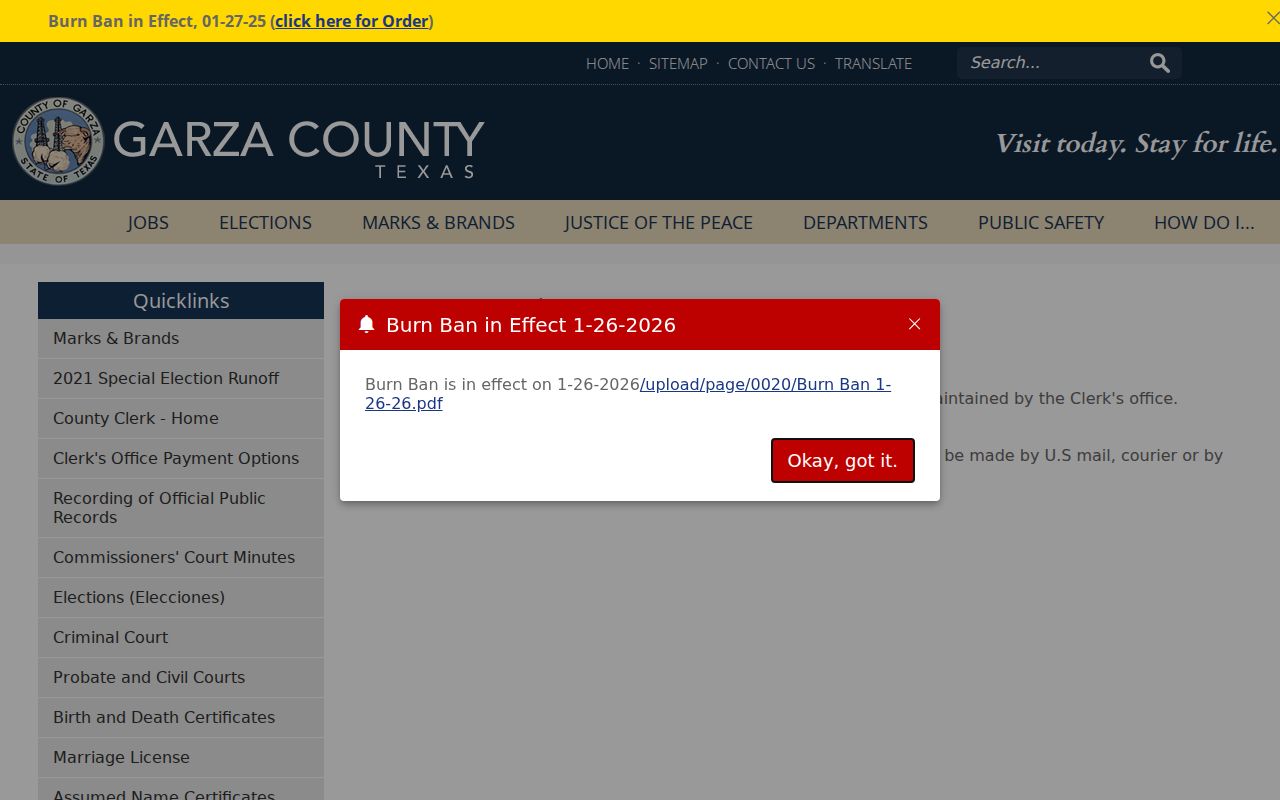
For incident and booking records, use the sheriff's separate form instead of sending the request to the clerk.
Garza Criminal Records Without a Portal
Garza County does not publish a local criminal case search, jail roster, warrant list, arrest blotter, or sample inmate profile. That gap changes the order of a useful search. Call the jail for immediate custody. Submit the sheriff form for an incident, arrest, booking, 911/CAD, or body-camera record. Contact the combined clerk for a filed case and certified result. Check the issuing court for a warrant.
Do not treat re:SearchTX as a complete criminal fallback.
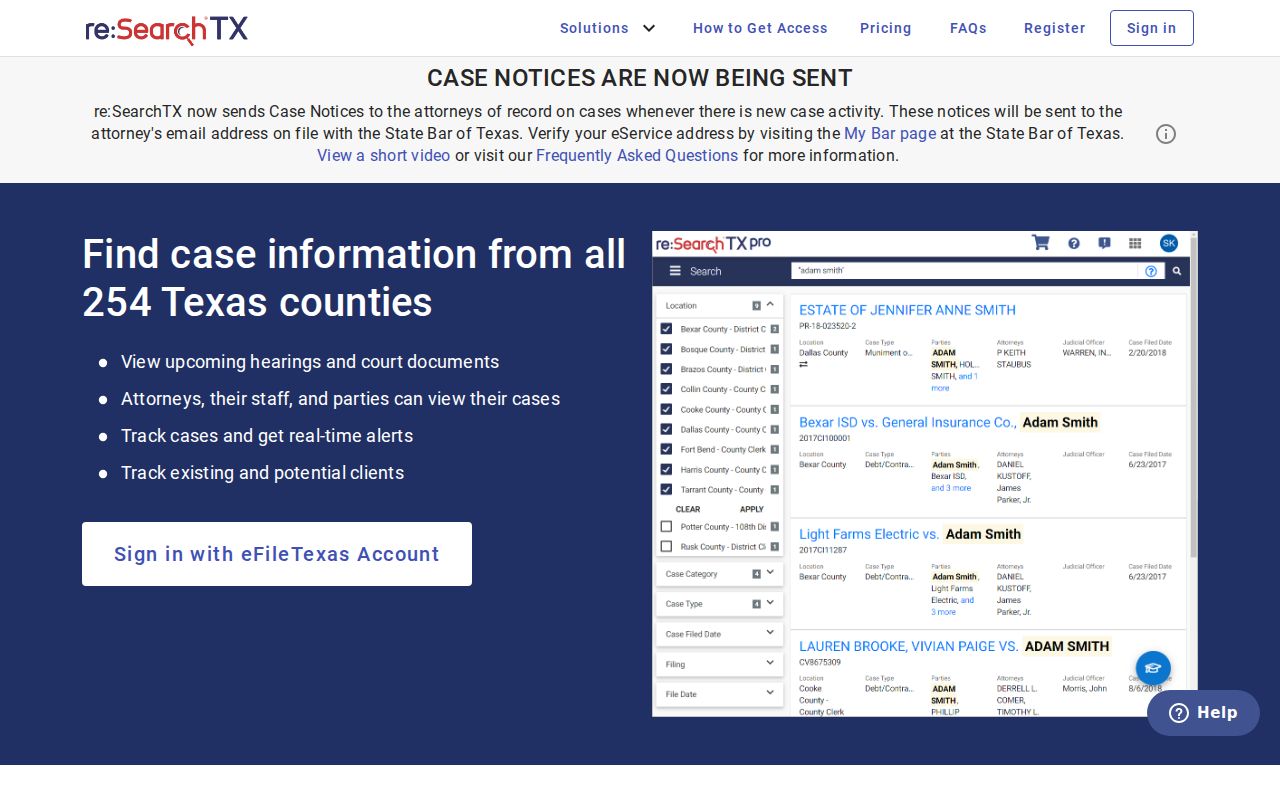
OCA reports that the statewide collection excludes criminal case records. Its general controls can search by county, court, case, party, and filing date, but direct contact with the Garza clerk remains the local route. A payment page is also not a case database. It requires the amount and docket or cause number, which a person must get first.
Note: County and justice-court payments do not recall a warrant until the payment posts, often on the next business day.
Restricted, Sealed & Expunged Records
Texas moved its expunction law to Chapter 55A on January 1, 2025. Expunction can remove or destroy qualifying arrest records. It is stronger than nondisclosure, which limits public release while criminal-justice and other named agencies retain access. A dismissal alone does not guarantee either remedy. The charge history, limitations period, related episode, prior supervision, and statutory ground all matter.
Common no-charge waiting periods are at least 180 days after a Class C arrest, one year for Class A or B, and three years for a felony, or the longer limitations period that applies. Acquittal, pardon, actual innocence, mistaken identity, and some overturned-conviction grounds follow different rules. The Garza clerk's dated schedule lists $277 for expunction and $28 for nondisclosure plus service costs, but current totals must be confirmed.
Start with the combined clerk and identify the original case and arrest. Ask which current Chapter 55A route or OCA nondisclosure packet fits, what copies are needed, and what service total applies. After an order, check both the local case and your fingerprint-based DPS record.
Note: Nondisclosure restricts public release, while expunction can remove qualifying records under a different statutory process.
Garza Arrest Record Request Details
The Garza County Sheriff's Open Records Request form asks for the requester's contact details, incident type and date, file number, location, and names of the people involved. Date of birth, age, race, and sex serve as locating details. The form states that GCSO has ten business days to process a request or may seek an Attorney General ruling. Pending litigation and protected material can limit release.
| Request Item | Posted Rule |
|---|---|
| Copies | $1 per page |
| More than 50 pages | Added cost may apply |
| Expected cost over $40 | Requester receives an estimate |
| Pickup | 15 calendar days after notice |
Confirm the accepted delivery method with the Law Enforcement Center before sending the form. Active investigations, juvenile information, victim identities, and protected personal information may be withheld or redacted. A detailed request is easier to route than a broad demand for all records about a name.
Garza County Registry Record Route
The Texas Public Sex Offender Registry is the official free state search for safety awareness. It supports name and location concepts using name, address, city, ZIP, county, and map controls.
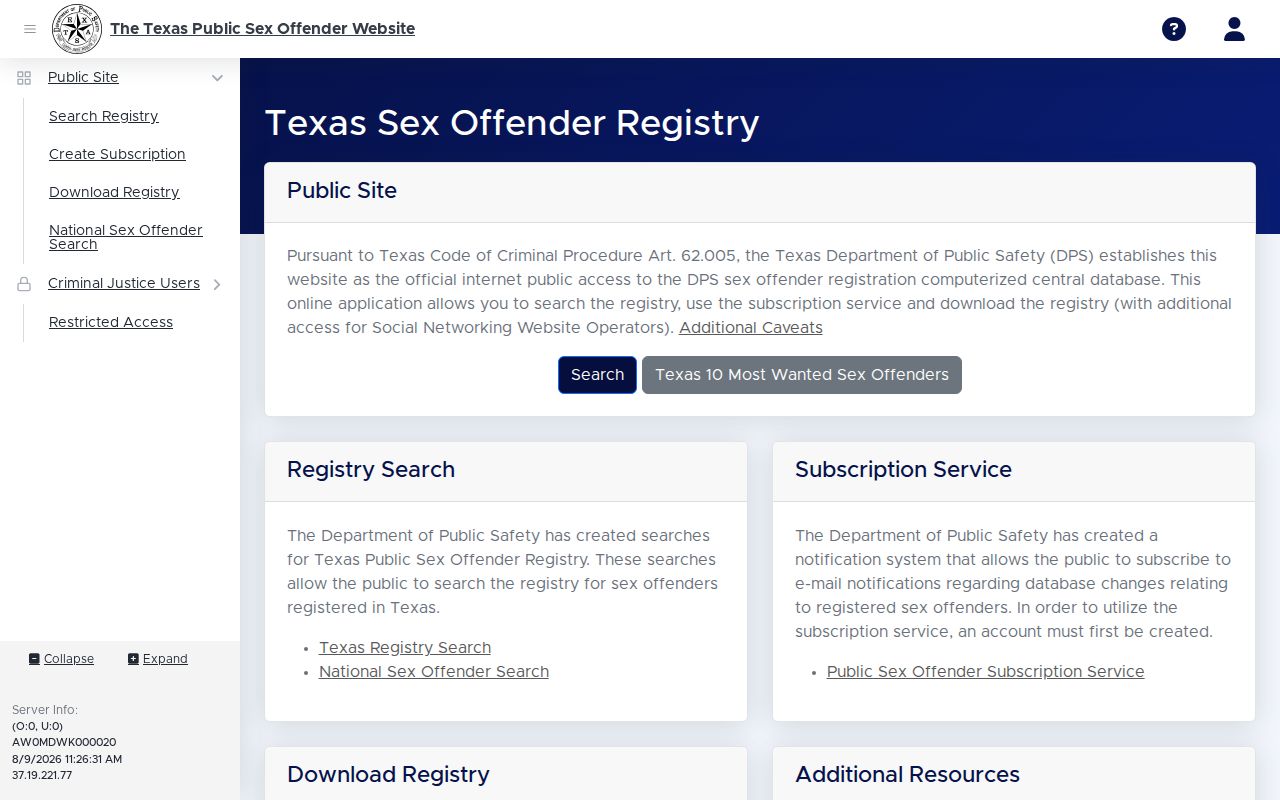
The registry can show identity, physical description, residence or geographic description, offense information, risk level, status, and registering authority when public. Exact radii were not verified, so none should be assumed. NSOPW adds a multi-state name, ZIP, and address-radius search. Texas DPS also advertises registry searches by location, name, route, and proximity in its mobile app.
Post lists no municipal police department. Texas law normally assigns registration inside a municipality to city police and outside it to the sheriff, so a Post resident should confirm the local process with GCSO. For a full lawful-use explanation, use the Garza County sex offender lookup. Harassment, threats, and retaliation remain unlawful.
Post Criminal Records Cross Two Buildings
Post is Garza County's only incorporated city. Its official department list shows no city police department, so local law-enforcement records route through GCSO. Post Municipal Court still keeps its own fine-only Class C traffic, criminal, ordinance, and animal-control case records at 106 South Broadway. Felonies and Class A or B misdemeanors move to county courts and the combined clerk at the courthouse.
A defendant may appear at Municipal Court in person or by mail. A phone call does not count as an appearance. FASTGovPay takes payments, but it is not a public case search. Deferred disposition and driving-safety options require court approval before online payment. A failure-to-appear warrant may require an appearance or written request, and a payment does not prove immediate warrant clearance.
The city department directory confirms the sheriff routing. The city guide below explains the municipal forms, county booking path, and local access rules in Post-specific detail.
City-by-City Criminal Records in Garza County
Official Census and state place files identify Post as the county's sole incorporated city, with a 2024 estimate of 3,594 residents. Close City, Justiceburg, Southland, and Graham are communities, not incorporated municipalities. The city list therefore contains one guide. It is not padded with a place that lacks a city government or with a neighboring county's municipality.
Post Record Check
3,594 residents · GCSO handles law-enforcement records, while Post Municipal Court keeps fine-only city cases.
Post's record geography is compact but split. The historic courthouse on West Main holds county court files. Municipal Court is on South Broadway. The Law Enforcement Center on East 15th holds sheriff, arrest, and adult jail records. Choosing the building by record type saves a missed stop.