
Garza County Sex Offender Checks
The Texas Public Sex Offender Registry is the first official source for a Garza County sex offender lookup. Texas DPS maintains the statewide portal, with fields for name, address, city, ZIP, and county. Select Garza as the county or Post as the city when that fact fits the search. Required-status rules and exact radius choices were not verified, so read those settings on the live form.
The National Sex Offender Public Website, or NSOPW, adds participating jurisdictions when a person or address may connect to another state. Neither tool replaces an identity match. Compare the image, age, aliases, traits, offense record, and registering authority. For a possible reporting issue, contact the Garza County Sheriff and Texas DPS instead of relying on a partial result.
Garza County Registry Search Paths
A name search and a location search answer different questions. A name search is strongest when the first and last name are known. It can reveal profiles tied to places beyond Post or Garza County. An address, city, ZIP, county, or map search instead begins with place. That route is better for community awareness near a home, school route, or family destination, but it still requires review of each returned profile.
NSOPW makes the split clear. Its name mode calls for both first and last name. Its ZIP alternative accepts up to five ZIP codes, while county and city or town fields can narrow results. Address Radius mode uses address, city or town, state, and a distance dropdown. Texas coordinate data can affect whether mapped results appear. The Texas portal also presents address and map concepts, but no unverified distance value should be treated as a fixed Garza County search option.
Note: A map point supports location awareness, but it does not prove that every person at that property is listed on the profile.
Texas Public Sex Offender Registry Searches
DPS runs the free Texas registry without a login requirement. Search with the most reliable fact available, then narrow toward Garza County. A county filter can find profiles registered within the county, while Post, an address, or a ZIP can focus on a smaller place. The portal is a public-safety source, not a substitute for the full criminal case file or a personal DPS fingerprint review.
- Open the official Texas DPS registry and read its current conditions and search controls.
- Enter a name, or begin with address, Post, ZIP, or Garza County location fields.
- Review the returned records and compare identifying details instead of relying on the name alone.
- Open the likely profile, read the offense, status, risk, and registering-authority fields, then verify a concern with the listed authority.
| Field Label | Type | Required | Notes |
|---|---|---|---|
| Texas Name | Text | Unspecified | Search a known name and confirm identity from profile facts. |
| Texas Address | Text | Unspecified | Starts a location or map-based search. |
| Texas City | Text or filter | Unspecified | Use Post for the county's incorporated city. |
| Texas County | Selection | Unspecified | Select Garza to focus the statewide records. |
| Texas ZIP | Text | Unspecified | Narrows the location search; confirm the live form's rules. |
| Texas Map or Proximity | Map controls | Unspecified | Exact radius choices were not verified. |
The live portal controls which fields must be filled. If one route produces no useful match, change the search mode rather than guessing at a distance setting.
Garza County Registry Results Across States
NSOPW adds a cross-state layer that the Texas-only search cannot provide. Use it when a full name may be tied to more than one jurisdiction or when a route reaches beyond Garza County. Search modes include first and last name, ZIP, county, city or town, multiple jurisdiction choices, and address-based fields. If a Texas result lacks usable coordinates, switch from the map to a name, ZIP, city, or county search and open the linked jurisdiction record.
The official federal multi-jurisdiction registry search shows the national interface used for that wider check.
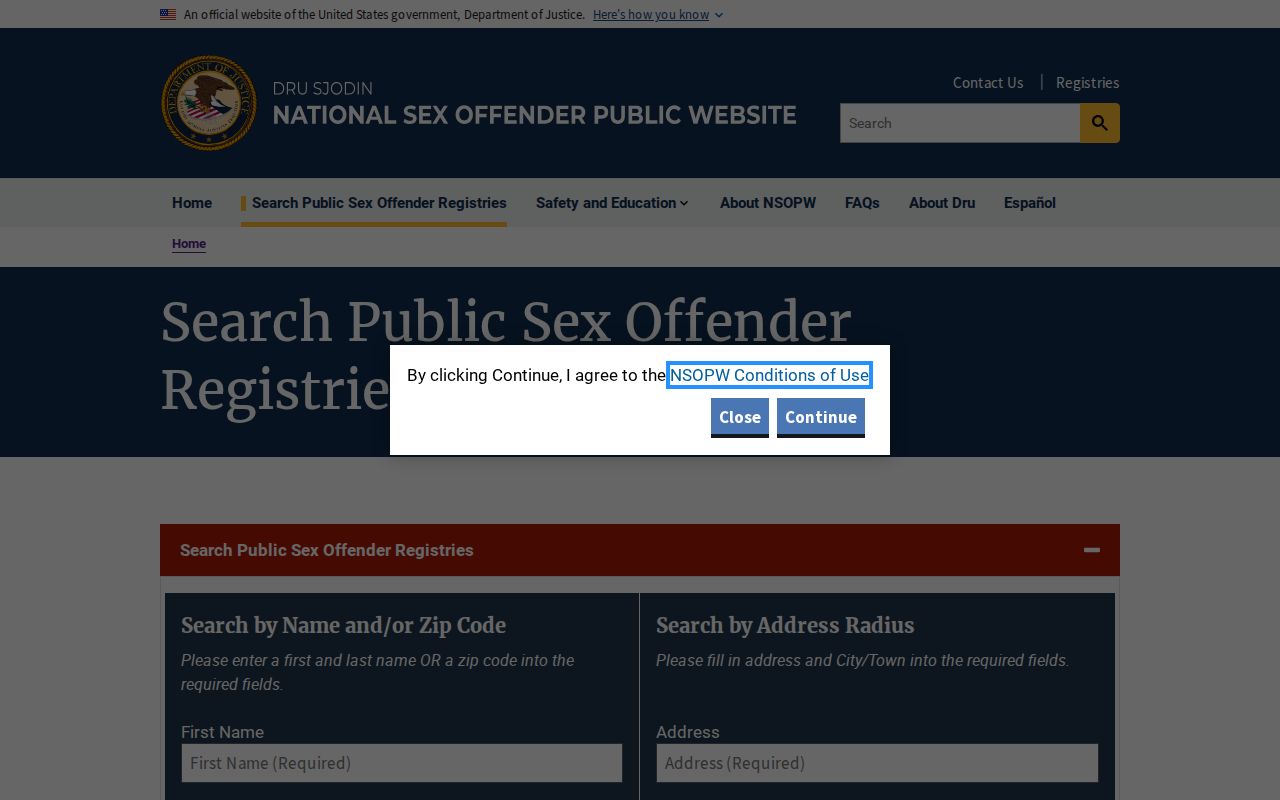
That extra layer helps a Garza County searcher follow a reliable lead without assuming that one state's map contains all public registry records.
Registry Profiles: What They Show
A Texas public profile can help confirm identity and registration status. It may show names, aliases, a photo, age or birth date, physical traits, residence or geographic description, offense details, victim-age category, conviction date, punishment, supervision or discharge status, risk level, and registering authority. Not every profile carries every field.
| Name and Aliases | Lists the public identity names connected to the registration record. |
|---|---|
| Photo and Physical Description | May show an image, age, sex, race, build, and eye or hair traits for identity comparison. |
| Residence | May provide a street address or a permitted geographic description. |
| Offense Record | May include the offense, victim-age category, conviction date, and punishment. |
| Risk Level | Shows Texas's assessment of low, moderate, or serious danger when reported. |
| Status and Authority | May identify supervision or discharge status and the agency responsible for registration. |
Article 62.005 keeps sensitive identifiers and victim-identifying data out of public display. The DPS CHRI dissemination and nondisclosure law also shows that public criminal-history access follows rules distinct from a registry profile.
Those separate limits explain why a registry screen should not be read as a complete Texas criminal-history report.
Garza County Registry Duties Without Post PD
Texas law generally assigns registration to city police for a person living inside a municipality and to the sheriff outside one. Post changes the normal local path because its official department directory shows no city police department. Available county and city sources point to the Garza County Sheriff as the main local law-enforcement channel, but no published source settles every administrative detail of registry check-in inside Post.
Call the Garza County Sheriff's Office before a registration visit or when a local profile needs authority-level confirmation. The office is at 412 E 15th Street in Post, and the published sheriff number is 806-495-3595. Ask where a Post resident must report, what proof is required, and when the responsible staff member is available. This avoids treating the statewide registry search screen as a local appointment system.
Note: The county announced a Garza County Sheriff app, but no stable verified feature list supports treating it as a registry tool.
Registration Levels and Duties in Texas
Texas risk levels describe an assessed chance of continued sexual conduct. They do not work like federal SORNA tiers, and a risk number alone does not set the registration term. The offense and statutory history control whether the period is ten years or life. Public visibility and community notice also follow Texas law, not a simple formula in which a higher number always means a longer term.
| Texas Concept | Meaning or Duration | Public Visibility |
|---|---|---|
| Level 1 | Low danger; unlikely to continue sexual conduct. Risk does not set duration. | Public fields appear when Chapter 62 permits; notice rules are separate. |
| Level 2 | Moderate danger; might continue. Risk does not set duration. | Public fields appear when Chapter 62 permits; notice rules are separate. |
| Level 3 | Serious danger; expected to continue. Risk does not set duration. | Can trigger enhanced community notification under Texas law. |
| Adult Lifetime | Applies to listed sexually violent, enumerated, or repeat-offense grounds. | Public display remains subject to Chapter 62 field rules. |
| Adult Ten-Year | Otherwise runs to the tenth anniversary of the later dismissal, discharge, or release set by law. | Public display remains subject to Chapter 62 field rules. |
| Juvenile Ten-Year Rule | Generally reaches the tenth anniversary of the later disposition or completion, subject to juvenile provisions. | Juvenile provisions can limit public access. |
Verification runs on a separate schedule. Read the duration ground, risk label, and reporting frequency as distinct parts of the Texas record.
Garza County Registry Verification and Reports
Verification frequency is another rule that should not be inferred from risk level. A civilly committed sexually violent predator verifies every 30 days. A person with two or more sexually violent offenses verifies every 90 days. Others generally verify once each year. The registering authority can explain how that schedule applies to a specific public record, while the DPS profile supplies the authority name and status fields that are safe to release.
Suspected failure to comply should be reported, not investigated by a private person. Give the Garza County Sheriff or DPS the profile link, observed issue, date, and location. Texas DPS Sex Offender Registration staff can be reached at 512-424-2800 or txsor@dps.texas.gov. Do not confront the person, publish accusations, or assume that an old address proves a new crime.
The TDCJ locator and parole-status phone channels provide a separate route for custody or release facts when a profile refers to supervision or discharge.
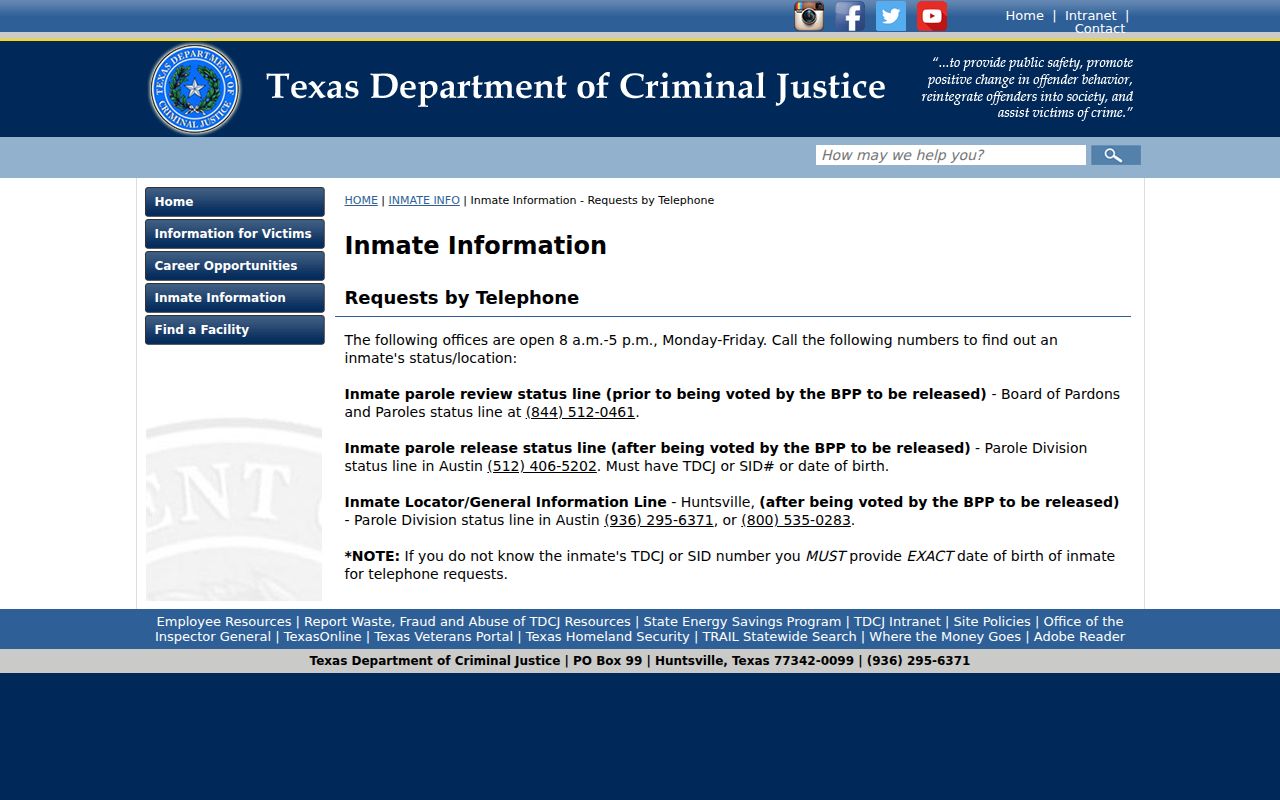
That distinction keeps a Garza County registry profile from being mistaken for the complete custody, parole, or court record.
Garza County Registry Risk Versus Duration
The easiest mistake is to read Level 1, 2, or 3 as a countdown. In Texas, those labels concern danger assessment. Duration instead turns on the qualifying offense and history described in Chapter 62. A Level 3 finding can lead to enhanced notice, while the legal registration term still depends on the statutory ground. Check both fields before explaining what the profile means.
High-risk postcard notification generally covers one mile in an area without subdivisions or three blocks in a subdivided area. That notification rule is not a general Garza County residence ban. Texas has no single statewide residence-distance rule, and no verified local Garza ordinance supports one here. Separate supervision terms can apply to one person, so a specific restriction must come from an official order or the responsible agency.
Using Registry Information Lawfully
Registry publication supports family safety and community awareness. It does not grant power to punish, follow, expose, or threaten a listed person or household. When a Garza County result raises concern, preserve the official profile link and contact the registering authority. Let law enforcement decide whether a status issue calls for action.
The Texas Public Information Act illustrates the wider rule that public access still has confidentiality limits.
Public availability therefore does not erase statutory limits, protected fields, or the need to verify a record with its source.
Use registry records lawfully: Texas Code of Criminal Procedure Chapter 62 governs publication and notification. Using registry data to harass, threaten, retaliate, or pursue vigilantism can be a crime under Texas law. Article 62.006's $1,000 civil provision is limited to commercial social-networking misuse, not every use of registry data.